NIO’s Silk Road Battery-Swap Route: Cost and Significance
NIO’s Silk Road Battery-Swap Route: What It Costs and Why It Matters
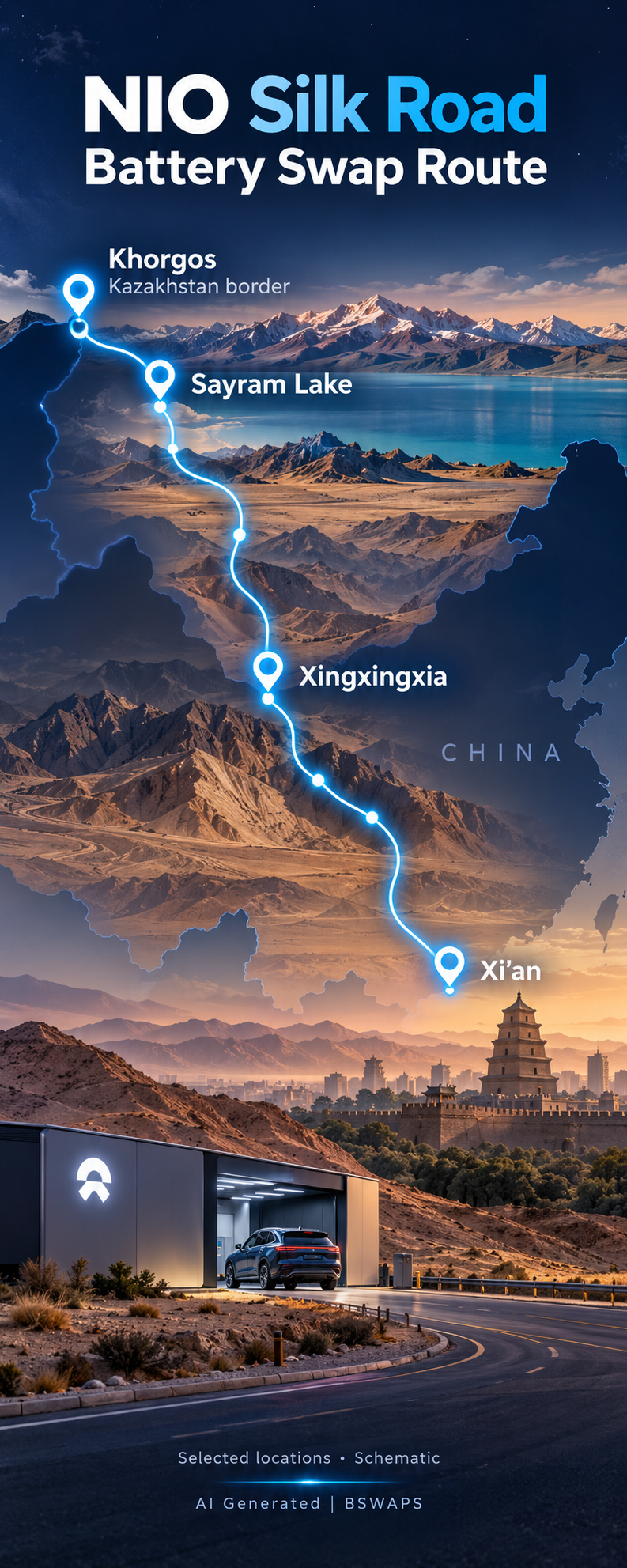
NIO completed its Silk Road battery-swap corridor on September 26, 2026, when a station at Sayram Lake opened in Xinjiang. The route connects Xi’an with Khorgos near the Kazakhstan border and includes 33 swap stations. Our illustrated map highlights selected locations along the corridor, including Xingxingxia and Sayram Lake; it is a schematic rather than a navigation guide.
What Does It Cost to Build?
A verified total construction cost for the Silk Road corridor was not available in the sources reviewed. However, NIO’s second-quarter 2026 results briefing provides a useful benchmark: approximately RMB 1.4 million for a fifth-generation swap station itself, excluding batteries and high-voltage infrastructure. Applying that benchmark to 33 stations gives RMB 46.2 million, but this is an illustrative calculation—not the corridor’s actual budget. Its stations may use different generations, and battery inventories, site preparation, electrical infrastructure, and the solar-and-storage installation require additional investment. See the published results briefing for the cost assumptions.
Why Is the Route Significant?
The corridor extends battery swapping beyond urban convenience to long-distance travel through western China. For drivers of compatible vehicles, connected stations provide another way to replenish energy while crossing areas with widely spaced services. The route’s completion is therefore a test of battery swapping as a regional transport network, rather than simply an individual roadside facility.
Xingxingxia adds another important element: a station combining solar generation and energy storage to operate off-grid. That approach could help provide EV services where electricity connections are difficult, although its costs and reliability must be assessed for each location. Commercial success across the corridor will depend on station use, operating expenses, and the number of compatible vehicles.
Read coverage of the completed Silk Road route, or return to BSWAPS’ latest battery-swapping news.